Choose your country:
Leadec global

Smart Stacking Aid: AI-Powered Sorting in Empties Management

Customer Case Study

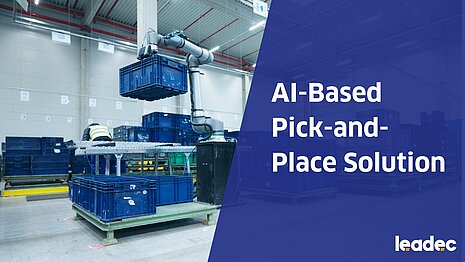
Approximately 12,000 small load carriers (SLCs) are sorted, inspected, and prepared for reuse every day in the empties management of an automotive manufacturer. Speed and accuracy are key—all the time. That’s why Leadec relies on a new AI-powered pick-and-place solution. It automatically recognizes the small load carriers, picks them up, and stacks them—thereby improving process stability and reducing the workload on employees. 

Identifying containers on the conveyor belt, gripping them, and stacking them neatly on pallets—that’s what the employees at the MDC plant in Kölleda do. Around 1,800 pallets of empties are processed here daily in two shifts. What sounds like a simple task is, in practice, a labor-intensive, repetitive process—and at the same time highly relevant to the production flow. After all, well-functioning empties management prevents production downtime and ensures that the right containers are available for production materials at all times.

Against this backdrop, Leadec sought a future-proof pick-and-place solution to stabilize processes, reduce manual labor, and specifically relieve employees. The goal is to automate a task that was previously entirely manual without fundamentally changing existing processes. For several months now, “Kalle”, as the team has named the collaborative robot (cobot), has been assisting with sorting.


It picks up the SLC containers with a suction gripper and stacks each type onto pallets according to specifications. This is made possible by the Vathos robot vision software installed directly on the cobot. Using a 3D camera and AI-based algorithms, the system can precisely detect and localize the various SLC types regardless of their position. To achieve this, the software was automatically trained using synthetic data of the various SLC types, enabling a precise, millimeter-accurate grip. 

200 SLC types in use

“A total of around 200 different small load carrier types are in use at the Kölleda site. In the first step, we opted for the two ‘high-runners’: one of the largest and one of the smallest SLC types. Together, these account for around 30 percent of the total volume. Our goal was to test the system’s performance at both low and high packing densities—that is, either 15 SLCs per pallet for the large type or 60 SLCs for the smaller type,” explains Stefan Hintz, Logistics Manager at Leadec in Kölleda. 


At the end of February 2026, the solution went into regular operation and is being further expanded. The goal is to have more than half of the small load carriers sorted automatically in the future. People and cobots work hand in hand in this process. The new colleague, Kalle, supports the team in ensuring consistent process quality and high availability. 


Quick Setup and Expansion 

“We deliberately chose a cobot to enable safe collaboration between humans and robots. In addition, a user-friendly interface makes setup and optimization easier. New small load carrier variants can be added quickly and without complex programming,” says Stephan Hihn, Global Head of Product Management at Leadec. The solution is also set to be deployed soon in other logistics centers operated by Leadec, opening up additional areas of application. 


This is where the technical flexibility of Vathos’ solution really pays off. It is hardware-independent and can be easily integrated into existing sensor, robotics, and IT infrastructures. “Our robot vision software supports common 3D sensors as well as various robot systems and communicates via standardized interfaces. The connectors for camera and robotics systems can be activated or swapped out via plug-and-play without integrators having to manually reconfigure settings. Object recognition itself is based on multiple combined AI models and enables reliable identification even in unstructured environments,” explains Nicolas March, CEO of Vathos.


Key information at a glance

Why is empty container management so important in automotive production?

Empty container management ensures that the right containers for production materials are available at all times. A smooth process prevents production downtime and is therefore crucial for a stable production flow.  
What challenge was Leadec seeking to solve with the new solution?

The manual sorting, inspection, and stacking of approximately 12,000 small load carriers daily is a labor-intensive and repetitive process. The goal was to automate these tasks, increase process stability, and specifically reduce the workload on employees.

How does the AI-powered pick-and-place solution work?

A collaborative robot (“Kalle”) uses a 3D camera and AI-powered robot vision software to recognize different types of small load carriers, picks them up with a suction gripper, and automatically stacks them onto pallets. The software was trained using synthetic data to enable precise, position-independent recognition.

What advantages does the use of the cobot offer in everyday operations?

The cobot ensures consistent quality, high availability, and relieves employees of repetitive tasks. At the same time, it enables safe collaboration between humans and machines as well as rapid adaptation to new requirements.

How scalable is the solution for future applications?

The solution is flexible and hardware-independent. New SLC types can be integrated quickly, and the technology can be easily integrated into existing systems. The goal is to automate more than half of the processes in the future and to deploy the solution in additional logistics centers as well.


You may also be interested in the following articles:

All
  • Portrait and quote of Astrid Lichtl-Dengl.
    Interview
    06/03/2026

    Leadec Industrial Cloud: Digital Power for the Production of Tomorrow

    The Leadec Industrial Cloud is our central platform for digital solutions in manufacturing. In this interview, Astrid Lichtl-Dengel, Manager of the AI Competence Center at Leadec, talks about the idea behind the platform, the collaboration of international teams, and why the cloud is much more than just a technical infrastructure.

  • Video
    04/28/2026

    AI-Based Pick-and-Place Solution for Empties Management

    Leadec has developed an automated pick-and-place solution for sorting, inspection, and preparation of small load carriers.
     

  • A male and a female Leadec employee looking at a tablet and monitoring the production of cleaning agents.
    Article
    04/23/2026

    The Leadec AI Competence Center Turns Innovation into Impact

    Artificial intelligence has become an integral part of everyday operations in many companies–including Leadec. However, there is a crucial step between initial experiments and real value creation: structure. Leadec is taking this step decisively with its new AI Competence Center.

  • Several forklift trucks in a warehouse
    Article
    01/29/2026

    The fitness tracker for intralogistics

    How many kilometers does an industrial truck travel per day on the factory premises? How often is it loaded, how often unloaded? Where does downtime occur? Questions that until now could only be answered with a great deal of effort. That changes with the digital solution TwinFleet from Leadec.

  • A Leadec employee driving with a forklift with a pallet of waste through factory.
    Article
    05/28/2025

    How Waste is Turned Into a Digital Data Stream

    With the solution "Digital Waste Tracking" (DWT) developed by Leadec, waste is digitally recorded and tracked at two sites of an OEM. Following a successful pilot project, the system entered regular operation in 2024. And most recently, everything has been running on Leadec’s own Industrial Cloud.